
category
Dec 9, 2025
Legacy Health Staff Say They'll Stay on Strike Until Company Offers Better Deal
Portland Mercury
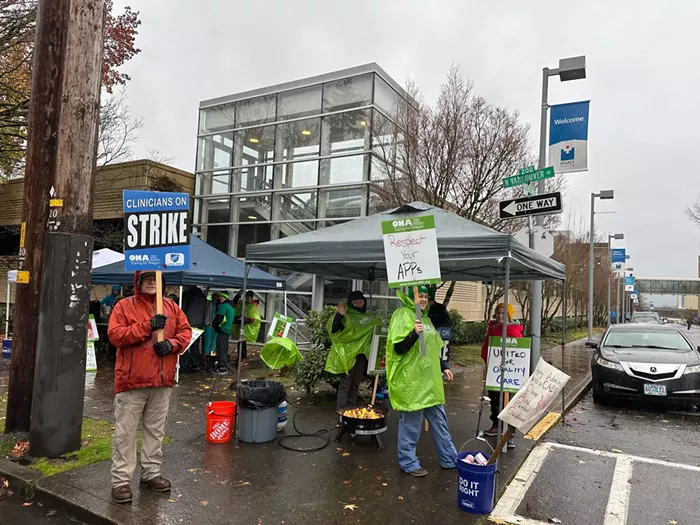
Legacy Health clinicians picket outside Legacy Emanuel Medical Center on Monday, December 8 during an ongoing labor strike. Taylor Griggs
Advanced practice providers at Legacy Health medical centers in Portland remain on strike this week, and say they'll stay on their picket lines until they reach an agreement for a new labor contract.
"The energy is high," Megan Barckert, a nurse practitioner at Legacy Cancer Services, told the Mercury from a rain-soaked picket line at Legacy Good Samaritan. "Our members are motivated and united in terms of our cause."
Advanced practice providers (APPs) are often nurse practitioners and physician assistants who, while not physicians themselves, have specialized training and are licensed to diagnose and treat a number of medical conditions.
The 135 APPs at Legacy facilities in Portland represented by the Oregon Nurses Association (ONA) began their strike on December 2 after months of bargaining with Legacy failed to yield a contract. The two sides were set to resume negotiations with a mediator on Monday morning.
Compensation has been a major sticking point in the negotiations. Legacy APPs say their rate of pay has fallen well behind that offered by other area hospitals like OHSU and Kaiser, which has meant that a number of APPs have departed Legacy for other opportunities.
Kevin Mealy, communications manager for ONA, said a new contract at OHSU means Legacy APPs are now being paid 10 to 12 percent less than their OHSU colleagues and are receiving eight to nine percent less in retirement pay -- opening up a 20-plus percent gap in total compensation.
Barckert said the effect of that gap is already clear. Because of how specialized their roles are, the departure of even small numbers of APPs can have effects across the Legacy system. Barckert pointed to the loss of an APP in palliative care, for instance, as impacting patients who never even worked with the provider.
"The loss of that provider [means] that we can't get our onc